Wednesday, July 31, 2013

Living in an English Speaking Country (1)

Those of you who are reading this post may have the strong desire (deseo) to conquer the English language. This may be possible in Spain, but if you want to learn quickly, the best place to acquire (conseguir) a high level of English naturally is in an English speaking country. Today we offer advice (consejo) on how you can take advantage (aprovechar) your time effectively when perfecting your English in such a country.

 
Working Abroad
Living in an English speaking country will probably means you will have to find work unless (a menos que)  you have a lot of savings.(ahorros) For those who are working for an international company, there may be positions advertised within (dentro de) your company. For example, a person who has worked for many years as an accountant (contable) for a multinational company in Spain may have the opportunity of working in a similar position in the UK. The company knows you already, you have the skills (habilidades) in the industry and you are given a challenge (reto) to perfect your English in an English working environment.(atmósfera)
       
 
Other Paid Work
The type of job that you can get depends on the type of training (formación) and qualifications you have already. There are always seasonal (de temporada) jobs in America, Britain and Australia at certain times of the year. For example, many Spanish people with some English may be able to take advantage of Bunacamp or Camp America, where they do various sporting or craft activities (manualidades) for American school children during their summer holidays. In Australia, you may find work on a sheep farm or fruit picking.(recogida de fruta) For both America and Australia you need to get working visas to legally work. There are no working visa requirements in the UK for Spanish nationals, who often work in hotels and restaurants. There are of course many other jobs available (disponibles) and can find the very latest jobs for English speaking countries at:
      

www.jobsabroad.com (Worldwide Jobs)
www.jobsearch.gov.au (Australia Jobs)

 
Voluntary Work
If paid employment is difficult to find, the next best thing is doing voluntary work. These experiences are likely (problable) to be very rewarding (gratificante) as you are not only practising your English, but you are also giving something back to society. Where can you work? Well, it probably best to work with the local community as you have a better chance (oportunidad) of developing relationships with local people. You should also work in something that will give you valuable experience for getting future paid work, giving you more skills and better English. Examples of voluntary work include working in charity shops, (tienda de segunda mano dirigida a causas benéficas) for the Red Cross, raising money (recaudando dinero) for local charities, or getting involved (implicándose) in environmental projects. Here is a useful website for voluntary positions: 
www.volunteerabroad.com/search 
    
 
Finding Work
A good place to find jobs are employment centres, temporary job agencies like Manpower and Adecco, and job advertisements in national and local newspapers. In all these cases, you need to take a proactive approach (enfoque), and be prepared to telephone the company for more information about the job, send off (mandar) an English CV and covering letter (carta de presentación) quickly and do some research on the company. With this strategy you will probably increase your chances of getting the job! Another excellent way of finding work is networking (establecimiento de contactos) with people you know. They may know of positions that occur before they are advertised. With this information, you may be able to get an interview with the company before it is advertised or at least get your CV and covering letter to the human resources department (departamento de Recursos Humanos) before anyone else.

Friday, July 26, 2013

French Connection

The Influence of French Words on English Vocabulary

In England in the mid-1400s, a large castle named Herstmonceux was constructed in Sussex. How was it – at a time when England was often at war with France- that a fine English castle was given a French name?

 Herstmonceux Castle in Sussex (England)

Although we think of England today as having its own culture,history and language, the fact is that during the Middle Ages,(edad media)  French culture, introduced after the Norman Conquest in 1066 , was very important in England. For more than three centuries after the conquest, the French language was used extensively in English society and the church and it was the official language of the English courts until the mid-16th century. This is the main reason why the  English we speak today contains many French words.

French words are everywhere

You' ll find French words in all sorts of places (todo tipo de lugares)- in cooking, fashion, the military and more. Most English speakers are unaware (ignoran)  that many of the words they use in English came, originally, from French. People learning English are often surprised to find French words appearing again and again. It takes them some time to realise that these words are as much a part of English as “real “ English words.

" French words are everywhere..."

Why French?

French-speaking people ruled  (governaban) England from 1066 A. D. and it is from that period that we get many of the words we now think of as exclusively English (e.g. "royal" and "pork" ). As the “black death" (peste negra ) killed many of the priests (sacerdotes, curas)  who often went to visit the sick and then became ill themselves, the language they spoke, Latin became less common in Europe. Educated people then relied upon French as the official language, one that commanded respect and admiration. As English developed , it borrowed  (tomó prestado) words from French to describe cooking, fashion and the arts.

French used to be the language of the upper classes (clases altas)  , of royalty and the aristocracy. French also became the official language of diplomacy and continued to be used until very recently. Many of the words and phrases in law , war and travel , which were originally French , have been incorporated into English.

And here are some examples ! Watch this interesting video to rapidly increase your French (an English ) vocabulary with just a few language tricks !

Tuesday, July 23, 2013

It's a boy !!!!

The Royal baby is here !


The Duchess of Cambridge Kate Middleton gave birth to a healthy baby boy yesterday in London at 4.24pm weighing 8lbs 6oz.* The future king was born in the same hospital where Prince William was born, the private Lindo Wing of St Mary’s Hospital in Paddington, central London.


William will now take two weeks of paternity leave ( baja por paternidad) from the Ministry of Defence before returning to his shift work duties as an RAF Search and Rescue pilot.
Bookmakers ( corredores de apuestas)  made George and James the favourites for the new prince's name. Henry , Alexander and Louis are also in the running (con posibilidades) .

*Measurements of weight   
1 ounce ( "onza" written abbreviation oz )  = 28,35 grams 
16 ounces   = 1pound  ( "libra" written abbreviation lb) = 453,6 grams
14 pounds  = 1stone  ( "piedra" written abbreviation st)  = 6,348 kilograms. 


Friday, July 19, 2013

Getting to Know Sushi


Sushi is a Japanese dish made of little rolls of rice with a garnish. (guarnición) The garnish is sometimes, but not always, raw fish (pescado crudo). The taste sensations, presentation of the dishes, colours and sounds that accompany a meal at a popular sushi bar make it a special experience, especially if you are actually in Japan.
         
In Japanese, “sashimi” is the word for raw fish, and “sushi” actually refers to the mixture of sweet vinegar and rice. So, if some of your guests (invitados) don’t like raw fish, you can make your sushi with cooked fish instead. Try (prueba) sushi with shrimp (gambas/langostino) or with vegetables (such as cucumber (pepino) and mushrooms (champiñones)), or with egg and vegetables.

There are four basic categories of sushi:


Chirashi – scattered (esparcido) sushi rice


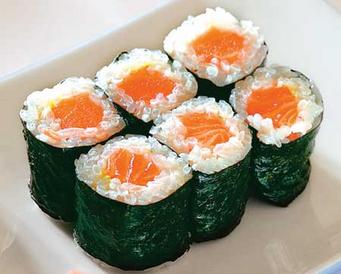
Maki – rolled (enrollado) sushi rice


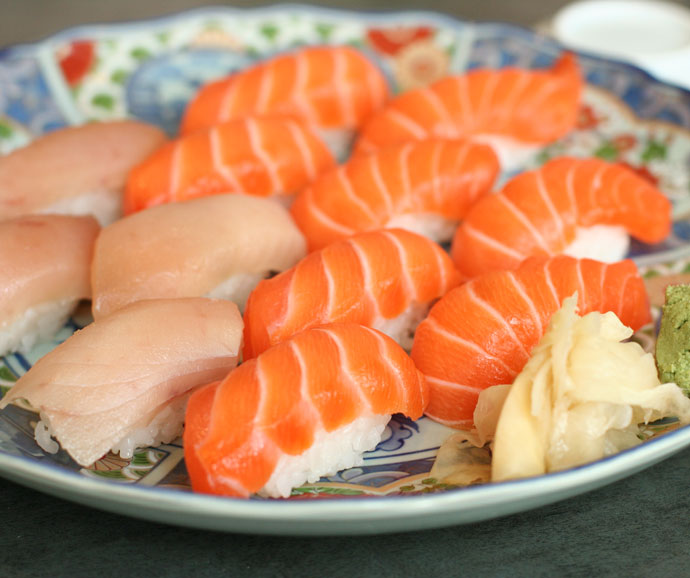
Nigiri – finger-shaped  (con forma de dedo) sushi rice


Oshi – pressed (presionado) sushi rice


Nigiri is the type of sushi that you usually see in sushi bars. But another popular kind, made by rolling the ingredients in a piece of seaweed, (alga) is the maki-sushi. It is easy to make.


Ingredients

Short-grain (de grano corto) rice, one cup per roll

Water

Sushi vinegar, 1 dessert spoon (cucharada de postre) for each cup of rice

1 cucumber cut into slices (rodajas)

Sheets (hojas) of nori (dried seaweed)

A bamboo mat (esterilla de bambú)


Method

Rinse (aclara) the rice for several minutes and then drain (escurre) it. Put equal quantities of rice and water in a large saucepan.(olla) Cook the rice. When it boils, cook for one minute, cover, and then simmer (cuece a fuego lento) for 20 minutes. The rice should not be too soft. Remove (retira) the rice from the heat and let it stand (déjalo reposar) for 10 minutes.

Put the rice in a large bowl and mix it with the sushi vinegar. Spread (extiende) the rice on a large sheet of aluminium foil to cool.(enfriar)

Put one sheet of nori on a bamboo mat. Spread the sushi rice on the nori. Put the cucumber slices on top of the rice. Roll up the bamboo mat so that the sushi is in a cylindrical shape. Press the mat so that the rice sticks together (se pegue) and then remove the mat from around the sushi. Cut the sushi into pieces and serve.